- 55,000 publications
- 41 companies
- 16 countries of development
- 71 countries of coverage (where news about autonomous vehicles was published)
- 2000-2020 period
Our database covers the global picture of autonomous vehicle making and might serve as a basis for strategic decisions in the areas of autonomous technologies, investment, and regulation.
Research approach and objectives
From the very beginning of our research, we aimed to cover the broadest possible understanding of autonomous cars. To build the most comprehensive picture of the industry, we focused on companies producing autonomous vehicles and their components. Our team of analysts examined information about each company, from their interactions with partners to the financial aspects of their projects.
Primary data source
We used Proquest’s Global Newsstream database as our primary source. This is a database of pre-selected news publications from around the world dating back to the 1980s. It includes newspapers, magazines, blogs, and web-only content.
Search parameters and keywords
We searched for keywords from the 2000s to the 2020s: “autonomous vehicle, self-driving car, autonomous car, automated car, self-driving vehicle.” This resulted in an archive of 55,000 publications mentioning self-driving cars.
Justification for using media sources
Manufacturers rarely share detailed information about their developments. Therefore, we used media reports, as well as financial reports, expert analysis, interviews with manufacturers, announcements, briefings, and public statements—anything that was publicly available. We collected data from open sources in both Russian and English.
English-language publications from the Proquest Newsstream database allow us to review the complex history of the development of autonomous vehicles from the 2000s to the 2020s. This data allows us to trace the evolution of the industry, identify key trends, understand the dynamics of investments and partnerships, and see how public perceptions of autonomous driving technologies have changed. At the same time, we take into account the biases of media coverage of autonomous vehicles and the activities of companies developing them, which requires a critical analysis of the information obtained.
Sampling
Company coverage
We collected data on 41 vendors from 16 countries. The project covered both the largest AVs makers and smaller, yet popular teams.
Selection criteria by type of transport
We considered only the AV companies developing passenger cars or small, low-capacity buses, which operate on public roads and are designed primarily for passenger transportation. However, there are many more modes of transportation, and they are also being automated: metros, trolleybuses, racing cars, delivery vehicles, trucks, and industrial shuttles. These were not included in our study sample.
Time frame
Our sample primarily included companies from the early 2000s to 2020. This study did not include numerous BA developments from the last century, although there is continuity between them and modern projects.
Selection criteria
A mandatory selection criterion was the company’s commitment to commercialization and the creation of a mass-market AVs. We focused on the size and significance of the projects, so many research, student, or amateur projects did not catch our eye.
Geography of media coverage
Global reach
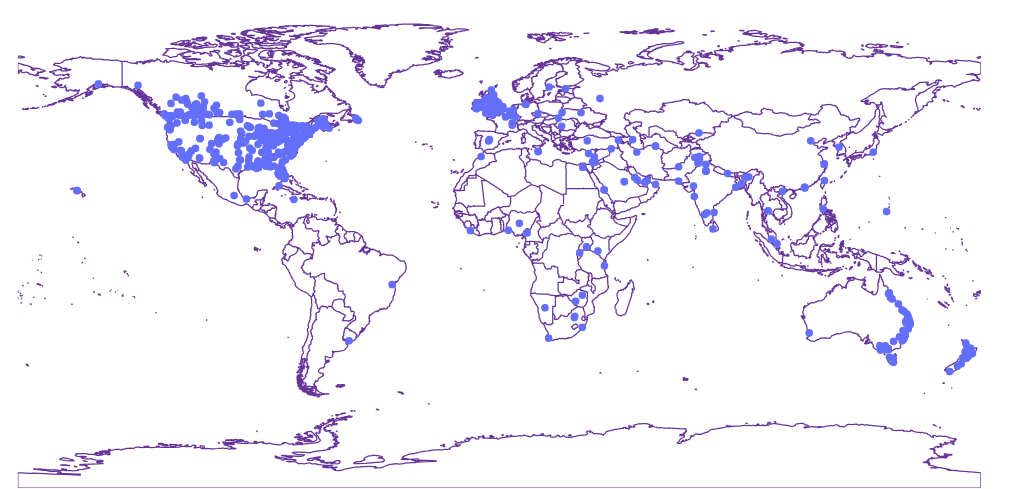
According to our data, AVs have been covered in more than 71 countries. The United States, home to approximately a third of all AVs projects, accounts for more than half of all news coverage. The next most frequently mentioned countries are England, Canada, India, and Australia. There are significantly fewer English-language publications from East Asia. For Russia, we compiled a separate news pool using Russian news aggregators.
Analysis of media publications
Our sample included over 3,000 publications worldwide. About half of the news came from just 1% of publications. These were the largest Western news agencies, newspapers, and magazines, primarily from the US and UK.
Top 5 publications by number of publications from our database
- Dow Jones Institutional News: A financial news agency that publishes economic, financial, and business news.
- Financial Times (and FT.com): A British business newspaper covering the global economy and business.
- Wall Street Journal: An American daily business newspaper covering finance, economics, and world news.
- New York Times: One of the most famous newspapers in the world.
- Washington Post: A leading American newspaper.
Methodological limitations
Limitations of the media as a data source
Data loss: Old news websites didn’t survive the study period, and some domains and news items disappeared or became difficult to access.
Specifics of media optics: The choice of topics and method of presenting information inevitably creates distortions. AVs projects, especially those of large companies, employ numerous marketers and brand promotion specialists. Partnerships are often mentioned by the company’s PR department or its partners. For example, information about AVs projects’ partnerships with other influential market players is aimed at creating and strengthening a positive image of the companies. This type of data inevitably predominates in our database. We attempted to triangulate it, searching for project descriptions from different participants and as close to the source as possible.
Uncontrolled negative coverage: Public scandals (e.g., the Uber self-driving car accident) or discrepancies between company statements and regulatory assessments are beyond the control of companies.
Limitations of research scope
We may have missed dozens of projects developing autonomous vehicles, and failed to cover how autonomous vehicles are being developed and tested in Africa, Latin America, Southern Europe, and Central Asia. We also left out groups dissatisfied with autonomous vehicles, such as transportation planners in Europe, anti-autonomous social movements in the US, and taxi and truck drivers around the world. They haven’t received media attention, but they exist.
Information about the projects is mixed. It appeared in different contexts, in different forms, and at different times. Some companies were often discussed in economic terms, while information about others was readily available regarding their technologies, and about others, nothing was known beyond rumors.
 MARTA: Картография беспилотных автомобилей