
What determines the success of autonomous driving technologies?
The autonomous vehicle (AV) industry is currently at a critical stage of development. The US and China are leaders in this field, possessing the necessary resources—finance, technology, skilled engineers, and political support. But what makes some companies more successful than others? A crucial factor is an ecosystem of partnerships and connections.
Our research shows that AV innovation requires a broad support network of diverse market participants providing technology, expertise, and services. At the same time, AV developers often engage in competitive rather than collaborative relationships with one another, striving to create their own unique ecosystem of partners.
How We Analyzed Company Networks: Research Methodology
Social network analysis is a methodology that allows us to study the structures of connections between different participants (in our case, companies). Imagine a map where dots represent companies and lines represent their partnerships and interactions. Such a map helps us identify not only obvious but also hidden connections, important intermediaries, and centers of influence.
Our analysis included two main approaches:
Visual analysis allowed us to see the overall picture of connections, identify clusters and isolated groups of companies.
Statistical analysis helped us accurately measure the importance of each company in the network and identify key players based on quantitative indicators.
Two types of graphs for a complete picture
We used two types of network models to capture different aspects of company interactions:
1.Bipartite graph: direct connections
This is like a map of direct flights between cities. Here we display direct connections between AV developers (e.g., Waymo, Baidu, Tesla) and their partners (automakers, tech companies, investors)
2. Graph Projection: Indirect Connections
This is like a map showing which cities are connected by connecting flights. Here, we transform the bipartite graph to see how AV developers are connected through common partners.
For example, if Baidu and Waymo both collaborate with Nvidia, they would be connected by a line in the projection. This allows us to see subtle connections and common interests even between companies that don’t directly interact.
How we measured the importance of companies: the centrality measure
The key metric in our analysis is a node’s degree centrality. This is analogous to the number of roads leading to a city: the more roads there are, the more important the city is in the transportation network.
In the context of our research:
For a bipartite graph, this is the number of direct partners for each company

For projection, this is the number of other AV developers with whom the company is connected through common partners

Companies with a high centrality score play a more significant role in the ecosystem: they have more opportunities to exchange information, resources, and technologies.
Identifying Clusters: Modularity Analysis
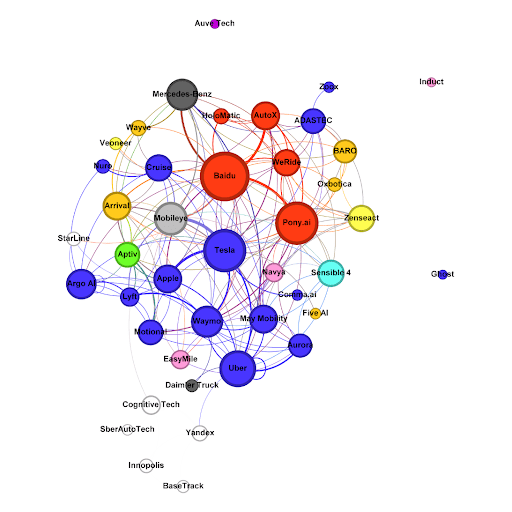
To understand whether distinct “teams” or “leagues” are forming in the autonomous vehicle industry, we used modularity analysis. This method identifies groups of companies that are more closely connected to each other than to other market participants.
These groups are visually represented by different colors on the graph. For example, we discovered distinct regional clusters (Chinese, Russian) and functional clusters (Waymo cluster, Tesla cluster, etc.).
Global Landscape: Who is Connected to Whom?
Our study features 41 AV companies:
- 15 American
- 14 European
- 6 Russian
- 5 Chinese
- 1 Israeli
We also analyzed 472 partner companies from various countries, including:
- 181 American
- 122 European
- 86 Chinese
- 27 Russian
- 17 Japanese
The number of connections between drone developers and their partners was 577. The number of indirect connections between AV companies through partners (142) significantly exceeds the number of direct connections (27), indicating the predominantly competitive nature of relationships in the industry.
Key Players: Who is Shaping the AV Technology Market?
Leaders among AV developers
The analysis identified the most influential developers of autonomous vehicles technology. Here are the top 5 companies ranked by network centrality (number of connections):
For direct connections with partners:
- Baidu (China) — 39 connections
- Arrival (UK) — 37 connections
- Tesla (USA) — 34 connections
- Mobileye (Israel) and WeRide (China) — 32 connections each
- AutoX (China) — 31 connections
In terms of centrality for projection, the top 5 vary slightly:
- Baidu (China) — 25 connections
- Tesla (US) and Pony.ai (China) — 21 connections each
- Uber (US) — 17 connections
- Mobileye (Israel) — 15 connections
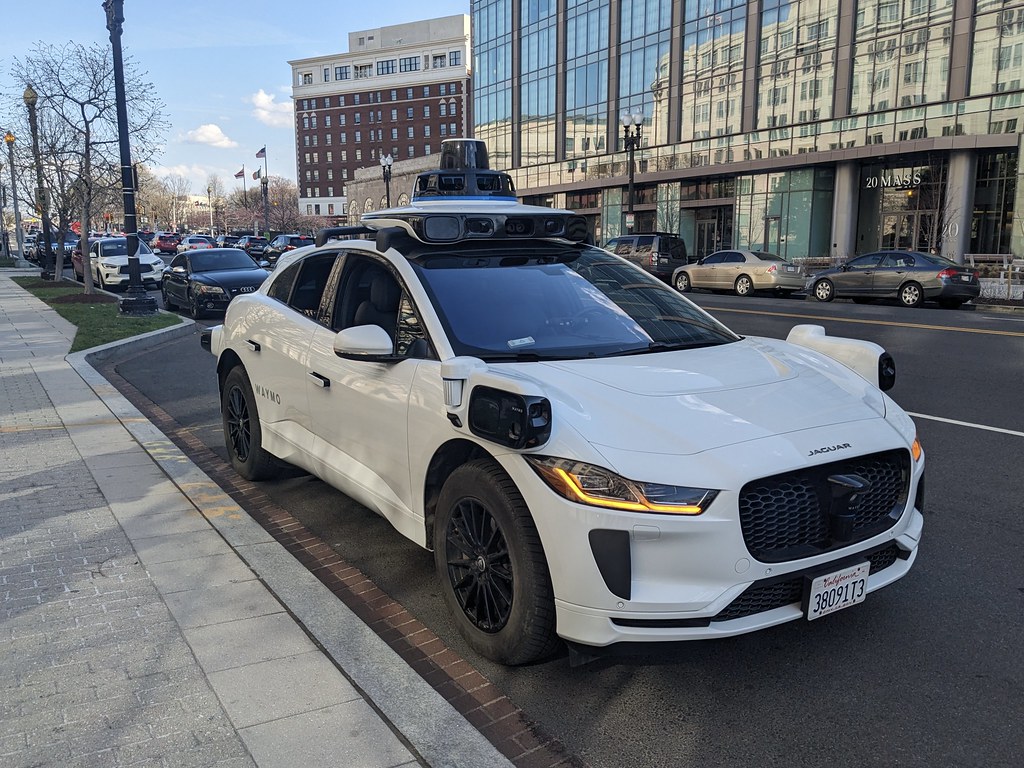
- Waymo (US) and Mercedes-Benz (Germany) — 14 connections each
Interesting cases of successful strategies
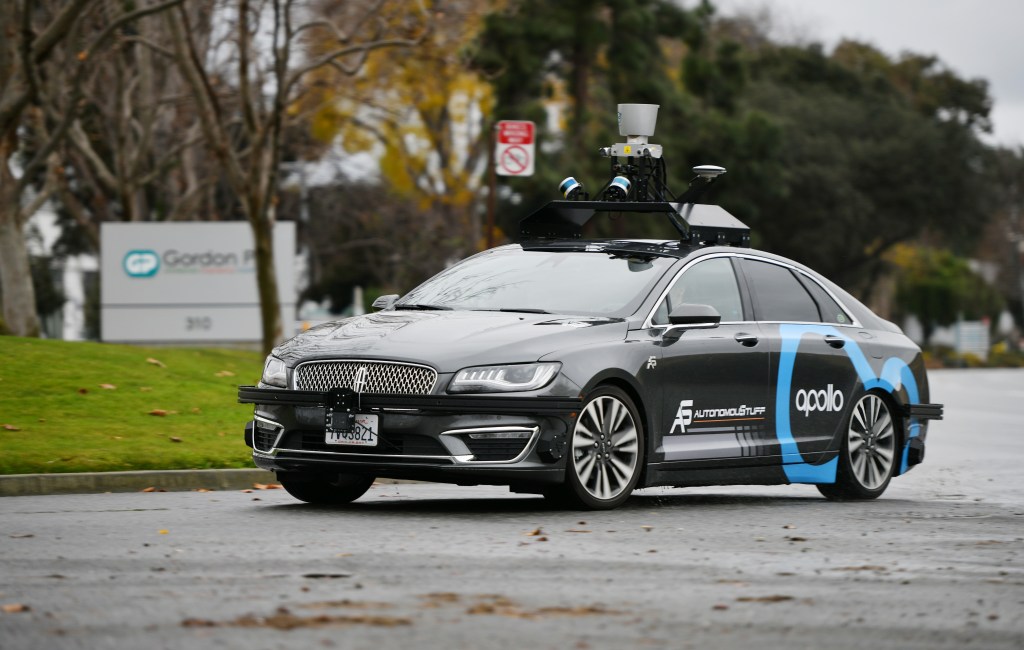
Baidu Apollo ranks first in centrality across both types of networks, demonstrating the company’s global influence. From the outset, Baidu has made networking a strategy, building an open-source platform rather than a proprietary technology.
Arrival demonstrates an interesting phenomenon: the company has numerous direct partners (ranked 2nd) but fewer shared partnerships with other autonomous vehicle developers (ranked 7th). This reflects Arrival’s ambitious mission to not only create highly automated vehicles but also develop “smart factories” for their rapid assembly.
Tesla and Mobileye rank highly, but pursue very different strategies. Tesla is known for its public aggressive style of communication, while Mobileye has built a vast network of partnerships, supplying ADAS systems to various automakers worldwide.
Key partners in the AV industry
Partner companies play a special role in the AV ecosystem. Here are the most influential:
- Nvidia (USA) – 9 connections with AV developers
- Toyota (Japan) – 6 connections
- Hyundai (South Korea) – 5 connections
- BlackBerry (Canada), Honda (Japan), Microsoft (USA), Via (USA), Volkswagen (Germany), and Volvo (Sweden) — 4 connections each
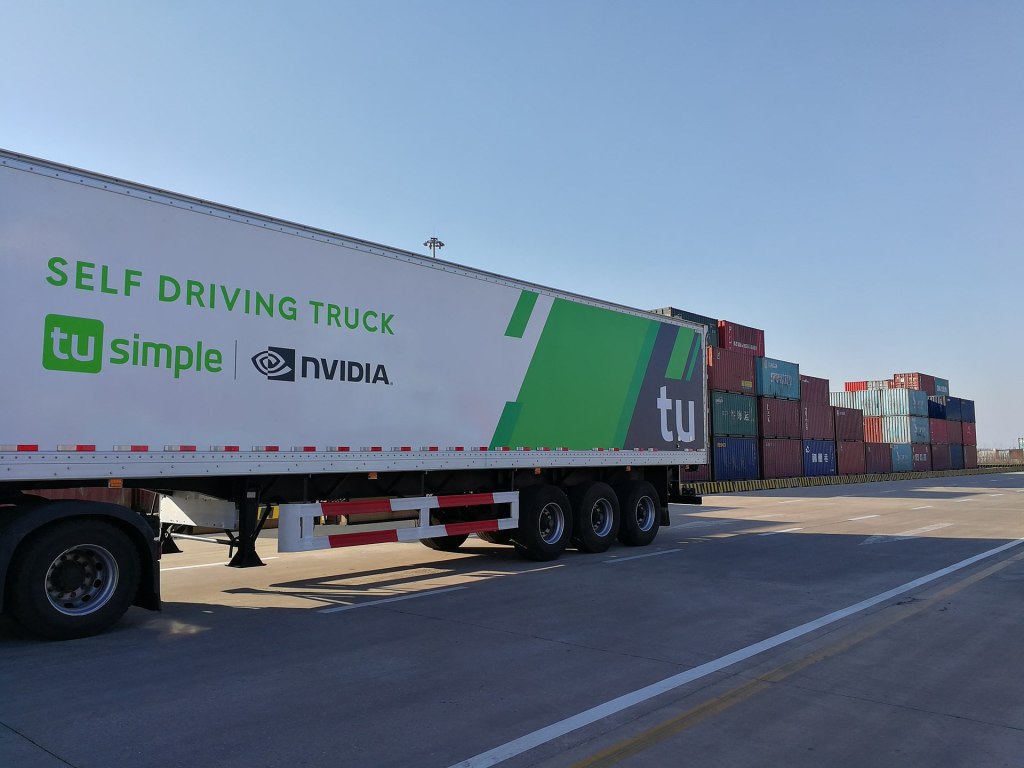
Nvidia is a very popular player in the AV car industry: it provides hardware and software for computing inside the computers of autonomous vehicles and produces products for autonomous vehicles (NVIDIA Hyperion, NVIDIA Drive, etc.). Many AV car companies from China, the US, Russia, and Europe work with Nvidia.
Traditional automakers are major players in the networks: Toyota, Hyundai, Honda, Volkswagen, Volvo, BMW, Ford, GAC Group, GM, and Kamaz support autonomous vehicles. Leading the way are Japanese and Korean automakers, which are actively involved in the autonomous vehicle industry. Toyota and Hyundai collaborate with many developers of sensors and software for autonomous vehicles, providing them with models designed specifically for autonomous testing, such as the Toyota Sienna and Hyundai Sonata.
Clusters and communities
Using modularity analysis, we identified several clear regional and functional clusters.
Regional clusters
- The Chinese cluster includes most Chinese companies and some European ones working with Chinese partners.
- The American clusters are divided into four groups (see below).
- The Russian cluster includes most Russian companies, with the exception of StarLine, which is part of the Waymo cluster.
Functional clusters
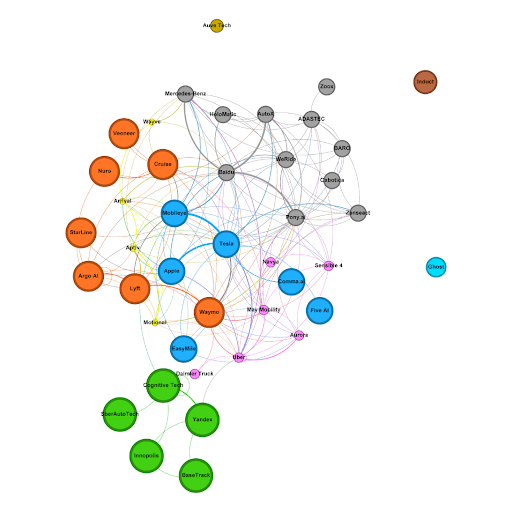
Beyond national specifics, the network is broken down into:
- Motional Cluster — is associated with the British companies Arrival and Wayve
- Waymo Cluster — includes Waymo, Cruise, Lyft, Argo Al, and Nuro
- Tesla Cluster — includes Tesla, Apple, Mobileye, Comma.ai, and others
- Uber Cluster — includes Uber, May Mobility, Aurora, and shuttle developers
National strategies and characteristics
Russian companies demonstrate a high degree of internal connectivity but are poorly integrated into the global market, focusing primarily on local partners.
Chinese companies form a strong cluster with the support of national investors and the government. At the same time, major Chinese developers, such as Baidu, WeRide, and AutoX, are actively developing international ties.
American companies are spread across several clusters, but they are all closely interconnected, reflecting the highly developed autonomous driving technology ecosystem in the US.
Conclusions: What determines success in the autonomous car technology market?
- Robotaxi manufacturers and major automotive companies (Tesla, Mercedes) are the most influential in the autonomous vehicle industry thanks to their extensive partnership networks.
- Developers of shuttles and alternative autonomous vehicles are less entrenched in partnership networks and are in low demand outside the European market.
- Autonomous technologies are not competing with the traditional automotive industry, but are actively integrating with it through partnerships.
- Geography plays an important role: companies from the US and China hold leading positions due to their access to capital, technology, and government support.
- An open platform strategy (like Baidu’s Apollo) facilitates growth in influence and the expansion of partnership networks.
- Diversification of partnerships increases the stability and influence of companies in the autonomous vehicle market.
An analysis of the global network of autonomous driving companies shows that success in this industry is largely determined by the ability to build effective partnership ecosystems, integrate with the traditional automotive industry, and adapt strategies to regional market specifics. The development of the autonomous driving industry is driving growth in related areas, such as sensor development, semiconductor design, and mapping services, thereby facilitating the development of tech industries beyond its own borders.
 MARTA: Картография беспилотных автомобилей