The development of autonomous vehicles (AVs) is one of the most ambitious technological advancements of our time. Behind every successful AV are hundreds of talented specialists from various fields. Who are these people? How are development teams organized? Why do some projects employ thousands of people, while others have only a few hundred? On this page, we will examine the “human factor” in the autonomous vehicle industry.
Team structure: the classical approach
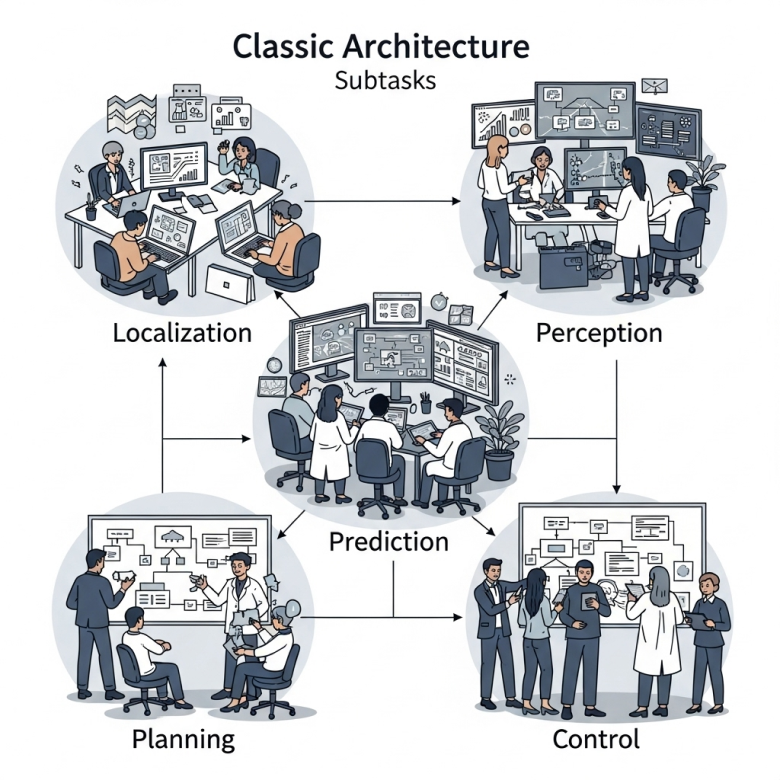
The structure of AV car teams reflects a fundamental approach to creating autonomous driving technologies. Most companies use the so-called classic approach—dividing the work into several key areas aligned with the architecture of the vehicle itself:
- Perception of the environment and recognition of objects around the autonomous car
- Localization and mapping
- Prediction of the actions of other road users
- Path planning
- Control of the AV car’s movement
In the classic approach, large projects are divided into teams specializing in one of these tasks. For example, at Cruise (one of the leading American companies in the autonomous vehicle space), the following teams exist:
Planning & Controls — planning and control of the autonomous vehicle’s movements. Programmers develop algorithms that plan the vehicle’s path and control its behavior.
Perception & Computer Vision — perception and computer vision. This team addresses the recognition of objects around the autonomous vehicle. These teams include data analysts and machine learning specialists.
Ground Truth — creation of datasets from sensor data collected during pilot drives. This team primarily consists of data analysts and data engineers.
Localization & Mapping — vehicle localization and high-resolution map management. This team includes data analysts, cartographers, and AI specialists.
Separate teams also work on the hardware: installing and maintaining sensors and connectors, and monitoring the vehicle’s operations. Engineers from various disciplines—automotive, electrical, and robotics—work here.
A crucial part of any AV project is safety drivers who test the vehicles on public roads. For example, Yandex’s self-driving project employed approximately 80 drivers in 2020, out of a total staff of approximately 300.
Talent Migration: How Ideas Spread Between Companies
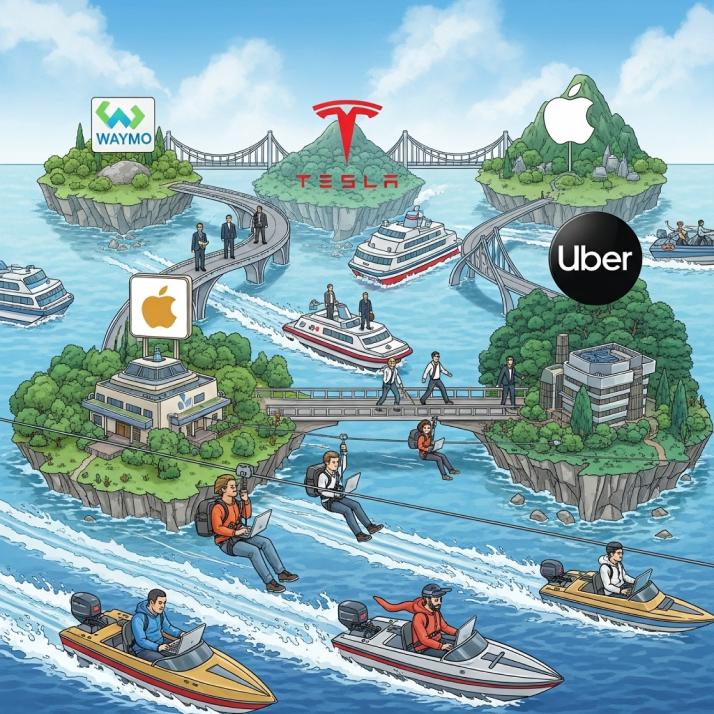
In the world of autonomous technology, specialists constantly migrate between companies. This is an important mechanism for disseminating knowledge and best practices within the industry. Many founders of their own companies previously worked on other drone development projects.
Company founders and their backgrounds
The career trajectories of the founders of autonomous driving companies allow us to trace the continuity between generations of technology projects.
- Pony.ai was founded by James Pang and Lu Tiancheng, both formerly of Baidu.
- Waymo is led by Dmitry Dolgov, who previously worked on autonomous driving at Google.
- Aurora Innovation was founded by Chris Urmson, also a Google alum.
- Argo.ai was founded by Brian Selsky, another former Google employee.
- Nuro was founded by Jinjun Zhu and Dave Ferguson, both formerly of Waymo.
- WeRide was founded by Tony Han, former chief scientist of Baidu.

These examples illustrate how experience working at large tech companies can become a springboard for creating their own autonomous startups. Moreover, most of these “migrations” come from two key sources: Google (USA) and Baidu (China).
Migration of top managers
Equally interesting is the migration of senior management. AV companies often lure talented executives from companies with completely different profiles:
- Cruise hired Gil West, who spent 12 years at Delta Air Lines, where he was responsible for operations at 366 airports in 66 countries.
- Apple poached several key Tesla employees, including Vice President of Engineering Chris Porritt and Chief Design Officer Andrew Kim.
- Several companies (Nuro, Zoox, Aurora Innovation, Waymo) have recruited former executives from US transportation regulators (NHTSA, NTSB).
- Taavi Rõivas, former Prime Minister of Estonia, has joined the board of directors of Auvetech.
Top management migrations influence the strategic positioning of companies and their interactions with the external environment—markets, regulators, and partners. But engineers and developers play a key role in the spread of technical practices.
Migration of engineers and the spread of the classical development model
Many engineers and programmers who worked on large autonomous driving projects eventually move to other companies, bringing established methodologies and approaches with them. Since teams are typically organized around a standard set of tasks—perception, localization, prediction, planning, and control—specialists gain experience within a specific function. By moving between companies, they replicate a familiar structure and work methods, thereby facilitating the spread of the classic autonomous driving development model across the industry.
Team Size: What Determines Headcount?
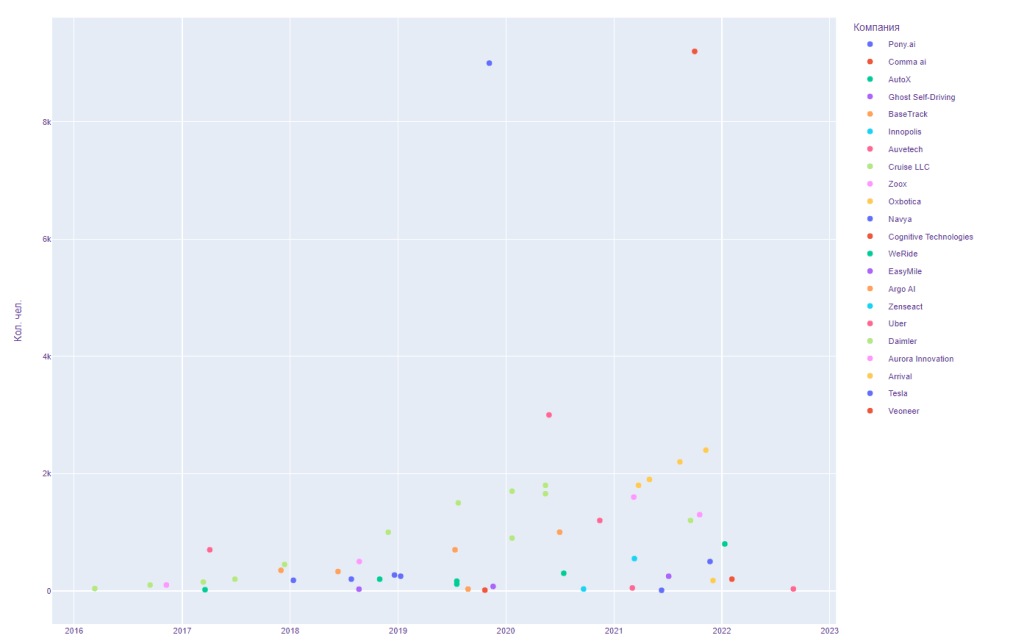
The number of employees in AV car projects varies significantly. This figure depends on several key factors: the company’s geographic location, the type of autonomous vehicle being developed, and access to investment.
Industry giants (2000+ employees)
Waymo: over 2,500 people (2023). This high figure is explained by the company’s being part of Alphabet (Google), which eliminates the need to constantly seek external funding.
Arrival: around 2,000 people (2020-2022), although the company reduced its workforce by more than 50% in 2022-2023 due to financial difficulties.
Market leaders (1500-2000 employees)
Cruise: 1,500-1,600 people (2020), with investment from General Motors
Aurora: 1,600 people (December 2020), which significantly increased its workforce after the inclusion of Uber’s self-driving division
Argo.ai: 1,000 people by mid-2021 (a 100% increase since 2018), with investment from Ford and Volkswagen
Players with a medium staff (1000-1500 employees)
Uber: 1,200 people (until December 2020, when the self-driving division was partially redirected to Aurora)
Daimler (Mercedes-Benz Group): 1,200 people (September 2021)
Zoox: 1,300 people (October 2021, up from 500 people in 2018 after the Amazon acquisition)
Developing projects (500-1000 employees)
WeRide: 800 people (January 2022)
Zenseact: 550 people (March 2021)
Pony.ai: 500 people (end of 2021)
Medium-sized companies (less than 500 employees)
Navya and EasyMile: 200-300 people
Yandex: 280 technical employees (2019)
Cognitive Technologies: 200 people
Oxbotica (Okha): 176 people (end of 2021)
AutoX: growth from 20 people (2017) to approximately 500 people (2024)
Regional and typological differences
Data analysis reveals a clear pattern: companies from the United States have the largest presence, followed by companies from China, and only then from the rest of the world. Furthermore, companies developing robotaxis tend to have larger staffs than those developing other types of autonomous vehicles.
This can be explained by their dependence on investors. Until autonomous vehicles reach the mass market and begin generating profits, investors provide projects with funding to hire qualified personnel. Finding investors is easier in the United States thanks to the developed venture capital ecosystem. In China, this is also possible thanks to government subsidies and the funds of major tech companies.
Robotaxis and autonomous delivery services present more understandable and attractive business models for investors, making it easier for them to attract funding than experimental projects or developments in freight transportation and public transportation.
From Technological Vision to Reality: The Role of People in Creating a Driverless Future
When discussing technical talent in innovative projects, it’s easy to fall into two extremes. The first assumes that the success of autonomous companies depends entirely on the genius of engineers and programmers, with technology merely the embodiment of their knowledge and abilities. This is precisely what Uber did when it tried to quickly develop an autonomous car, poaching half of its robotics team from Carnegie Mellon University and offering them high salaries. However, this approach failed to achieve the company’s desired results.
The second extreme is viewing people simply as easily replaceable resources for realizing the vision of top management and investors. The reality lies somewhere in between: the successful development of autonomous driving technologies requires talented specialists, as well as effective organization, access to resources, and a clear strategic vision.
Conclusions
- The classic approach to autonomous vehicle development dominates the industry, dividing teams into functional areas: perception, localization, planning, and control.
- The migration of specialists between companies plays a key role in the dissemination of knowledge and approaches to the development of autonomous technologies, contributing to the global adoption of the classic model.
- Team sizes vary significantly depending on geography and the type of vehicle being developed: American companies developing robotaxis have the largest staffs (1,500-2,500 people).
- Access to investment remains a critical factor determining the ability to hire qualified specialists and, consequently, the pace of development of autonomous technologies.
- The versatility of skills allows specialists to move between different types of autonomous projects, as demonstrated by the example of Tesla, which hired personnel from companies developing robotaxis.
The development of autonomous technologies is a complex process in which technological solutions and the human factor are intertwined. The migration of specialists between companies plays a key role in this process: it allows for the dissemination of knowledge, the transfer of proven best practices, and the development of a common understanding of what autonomous driving technologies should be. Talent becomes an integral part of the ecosystem, providing companies not only with the necessary skills but also with a shared vision of the autonomous future.
 MARTA: Картография беспилотных автомобилей